
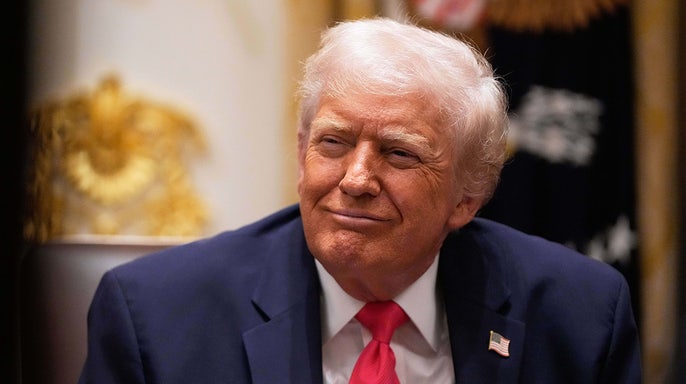
Trump ramps up immigration crackdown with expanded US travel ban
On Tuesday, US President Donald Trump drastically extended a travel ban by prohibiting citizens of seven other nations, including Syria, as well as holders of passports from the Palestinian Authority, from entering the country.
With this latest action, the number of nations whose residents are prohibited from entering the United States based only on their nationality now stands at roughly 40. Trump has also tightened regulations for regular travel from Western countries.
It occurs when Trump, who has long made immigration antipathy a signature issue, issues orders for mass deportations and becomes more vocal in his criticism of non-white newcomers to the United States.
Foreigners who “intend to threaten” Americans are prohibited, according to a proclamation issued by the White House.
Trump also wants to prevent foreigners in the United States who would “undermine or destabilize its culture, government, institutions or founding principles,” the proclamation said.
Syrians were banned days after two US troops and a civilian were killed in the war-torn country, which Trump has moved to rehabilitate internationally since the fall of longtime ruler Bashar al-Assad.
Syrian authorities said the perpetrator was a member of the security forces who was due to be dismissed for “extremist Islamist ideas.”
The Trump administration had already informally barred travel for Palestinian Authority passport holders as it acts in solidarity with Israel against the recognition of a Palestinian state by other leading Western countries including France and Britain.
Other countries newly subjected to the full travel ban came from some of Africa’s poorest countries – Burkina Faso, Mali, Niger, Sierra Leone and South Sudan – as well as Laos in southeast Asia.
In a series of new actions, Trump also imposed partial travel restrictions on citizens of other African countries including the most populous, Nigeria, as well as Ivory Coast and Senegal, which qualified for the World Cup set to be played next year in the United States as well as Canada and Mexico.
The Trump administration has promised to let in athletes for football’s signature competition, but has made no such promises for fans of blacklisted countries.
Other countries slapped with partial restrictions were from Africa or largely Black nations in the Caribbean – Angola, Antigua and Barbuda, Benin, Dominica, Gabon, The Gambia, Malawi, Mauritania, Tanzania, Zambia and Zimbabwe – plus the Polynesian country of Tonga.
Angola, Senegal and Zambia have all been prominent US partners in Africa, with former president Joe Biden hailing the three for their commitment to democracy.
Ramping up anti-immigrant tone
Global Refuge, a Christian-based group that supports refugees, warned that the travel ban would push vulnerable people further into harm’s way.
“The administration is once again using the language of security to justify blanket exclusions that punish entire populations, rather than utilising individualised, evidence-based screening,” said the group’s president and CEO, Krish O’Mara Vignarajah.
Trump has used increasingly loaded language, complaining at a rally last week that the United States was only taking people from “shithole countries” and instead should seek immigrants from Norway and Sweden.
He also recently described Somalis as “garbage” following a scandal in which Somali Americans allegedly bilked the government out of money for fictitious contracts in Minnesota.
Trump had already banned the entry of Somalis. Other countries remaining on the full travel ban are Afghanistan, Chad, the Republic of the Congo, Equatorial Guinea, Eritrea, Haiti, Iran, Libya, Myanmar, Sudan, and Yemen.
Trump last month made the ban even more sweeping against Afghans, severing a program that brought in Afghans who had fought alongside the United States against the Taliban, after an Afghan veteran who appeared to have post-traumatic stress shot two National Guard troops deployed by Trump in Washington.
The White House acknowledged “significant progress” by one initially targeted country, Turkmenistan.
The nationals of the Central Asian country will once again be able to secure US visas, but only as non-immigrants.
Trump has also all but ended refugee admissions, with the United States now only accepting South Africans from the white Afrikaner minority.