
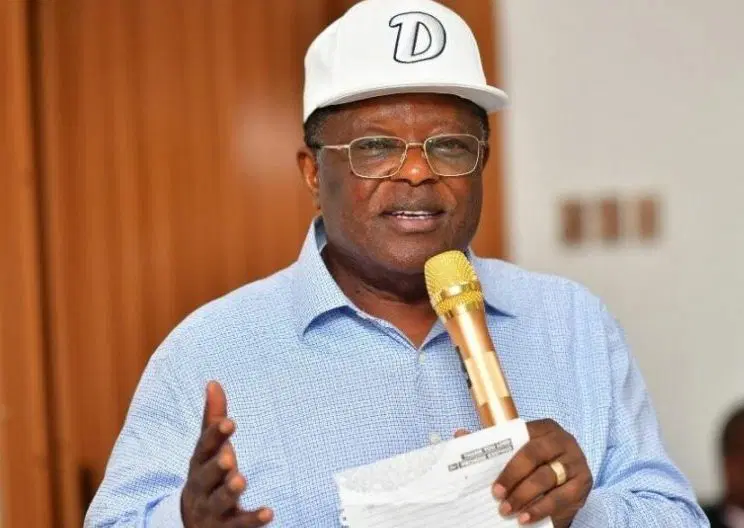
Minister of Works, David Umahi, has stirred fresh political debate ahead of the 2027 general elections after declaring that former Anambra State governor, Peter Obi, is not the best presidential candidate the South-East can produce.
Umahi made the remarks during an interview with ARISE News, where he argued that Obi’s 2023 presidential ambition lacked adequate consultation with political leaders across the South-East. He insisted that his position was not based on personal hostility towards the former Labour Party presidential candidate, but on what he described as the need for broader regional consensus in national politics.
“Peter Obi is not the best of our finest in South-East,” Umahi said. “He’s not the best; he can never be the best.”
The former Ebonyi State governor maintained that any politician seeking to present himself as the presidential choice of the South-East must first engage governors, party leaders and other influential stakeholders in the region. According to him, presidential politics cannot be successfully pursued in isolation from the political structures and leaders whose support may be required to build a viable national coalition.
“You cannot play politics in South-East without consulting people like us,” Umahi said. “If I were contesting, I would have consulted.”
Umahi challenged the belief that Obi should automatically be regarded as the South-East’s strongest presidential option simply because of his performance in the 2023 election, when he won widespread support across the region. The minister argued that the South-East has several qualified politicians capable of aspiring to the presidency and that the region should not be reduced to a single candidate.
He also rejected the suggestion that Anambra State should automatically produce Nigeria’s president whenever the South-East gets the opportunity. Umahi noted that Nigeria’s first president, Dr Nnamdi Azikiwe, hailed from the area now known as Anambra State, and argued that other South-East states must also be considered in future political arrangements.
According to him, Ebonyi, Enugu, Abia and Imo should have equal opportunities in discussions about producing a president from the region. He said the South-East’s presidential ambition should be built on fairness, inclusion and strategic negotiation rather than on the dominance of one state or one politician.
Umahi’s comments came amid increasing political activity ahead of the 2027 presidential election, particularly as some South-East leaders have begun openly supporting President Bola Tinubu’s re-election bid. The minister defended those leaders, rejecting suggestions that backing Tinubu amounts to a betrayal of the South-East.
He argued that political support should be judged by strategy and national interest, not by loyalty to a particular individual. Umahi maintained that the South-East could improve its chances of producing a president through alliances and negotiations with other regions of Nigeria.
“The South-East must build bridges if it wants to produce a president,” he said. “No one politician should be treated as the only viable option.”
Umahi further dismissed claims that Obi poses a major threat to President Tinubu ahead of the next election. He said the South-East’s voting pattern in 2023 was influenced by anger over perceived marginalisation under the previous administration, adding that the Tinubu government had taken steps to address the region’s concerns through appointments and federal projects.
He expressed confidence that the region would vote differently in 2027, arguing that voters would assess the administration based on infrastructure, inclusion and political engagement rather than sentiment.
Umahi’s remarks are likely to intensify the ongoing contest for political influence in the South-East ahead of 2027. While supporters of Obi view him as the region’s most credible national figure, Umahi and other political leaders insist that the path to the presidency requires consultation, coalition-building and a wider distribution of opportunity across the five South-East states.
As the 2027 race approaches, the debate underscores a deeper question within the region: whether the South-East’s best chance at the presidency lies in rallying behind one popular candidate or in building broader alliances across Nigeria’s political landscape.