
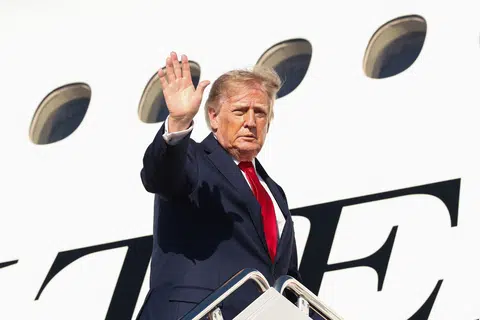
President Donald Trump reacted sharply to the Federal Reserve’s decision to raise interest rates on Wednesday, demanding that borrowing costs be slashed dramatically — even as the central bank, under his own appointee Kevin Warsh, moved in the opposite direction.
Trump responded to the rate hike late Wednesday by declaring on Truth Social, “LOWER THE INTEREST RATES FOR THE UNITED STATES OF AMERICA, AND FAST!” arguing the benchmark rate “should be 1% or less” given what he called America’s “Best Credit” standing globally. He added: “If we stopped Trading with every country that we have a Deficit with, which is most of them, we would make, at least, 1.5 Trillion Dollars a year,” and complained that the U.S. is effectively “carrying” nearly every other country.
Fed raises rates for first time since 2023
The Federal Reserve’s quarter-point hike brought its flagship rate to a range of 3.75% to 4.00%, marking the first increase since 2023. The move was unanimously backed by Fed policymakers, who also signaled that another hike could come before year’s end.
This was the first policy move by Kevin Warsh since Trump elevated him to the Fed chairmanship — a striking twist, given that Trump had specifically picked Warsh with the expectation he would deliver the “lowest rates” in the world.
Warsh defended the decision plainly, telling reporters: “The plain fact is that inflation is too high and has been for too long.” He also argued the hike would “support a timelier return” to the Fed’s 2% inflation target, saying he “would be hard pressed to describe broad financial conditions as restrictive.”
Trump reveals he spoke to Warsh ahead of the vote
In an unusual disclosure, Trump told reporters Wednesday evening that he had spoken with Warsh ahead of the vote, saying, “I talked to Kevin and I said, ‘you might as well vote with the board because it’s not going to matter.'” Warsh sidestepped questions about any conversation with the president during a press conference the same day, telling reporters, “I’ve got nothing for you on a discussion with the president.
Despite the tension, Trump said he still has confidence in Warsh, though when asked whether he believed Warsh’s decision was shaped by their conversation, Trump replied, “No, I don’t think so.”
White House pushes back on the Fed’s reasoning
Senior Deputy Press Secretary Kush Desai criticized the move in a Fox News appearance, calling it a “rather unfortunate decision by the Federal Reserve” that was “not backed by a particularly compelling economic case.” Desai further argued that current price increases are “entirely driven by an energy supply shock” — a characterization at odds with Warsh’s own explanation for the hike.
Markets react, more hikes possible
Major stock indexes reversed course as Warsh spoke, with the S&P 500 closing down 0.4% and the Dow falling 630 points, dragged lower by declines in IBM, Goldman Sachs, Boeing and American Express shares.
New projections released alongside the decision showed that 12 of 18 top Fed officials anticipate at least one more rate hike before the end of the year. Fed officials now expect the federal funds rate to end 2026 at 4.1%, up from a June projection of 3.8%, with no cuts anticipated in 2027 either.
Brian Rehling, co-head of global fixed income at Wells Fargo, said the move sends “a clear message that the Fed will not tolerate inflation drifting further above target, even in the face of political pressure from the White House.”