
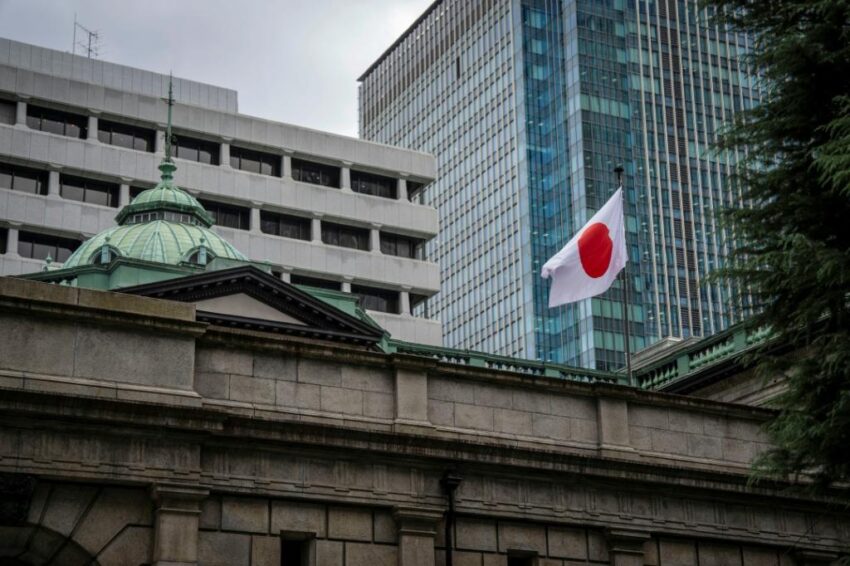
TOKYO — The Bank of Japan looks set to raise interest rates again this week, aiming to counter inflation driven by surging energy prices and to shore up the yen, all while operating under close watch from Washington.
The move would follow similar action abroad: the Federal Reserve raised its benchmark rate to roughly 3.9% on Wednesday, while the European Central Bank announced its own increase last week.
For the BOJ, which meets Thursday and Friday, the outcome appears largely settled — some officials have already signaled they intend to raise the key rate by 0.25 percentage points, bringing it to 1.25%, the highest level in more than three decades. The central bank’s last hike came in June.
Inflation and a weak yen driving the decision
Pressure has been building on Japanese policymakers to raise borrowing costs as oil prices — pushed up by the ongoing Middle East crisis, which shows no signs of resolving soon — continue fueling inflation. At the same time, the weak yen is making imported goods more expensive, and inflation accelerated in July, moving closer to the BOJ’s 2% target.
Takehiko Nakao, Japan’s former currency chief and former president of the Asian Development Bank, said a hike to 1.25% at the September meeting has already been priced in by markets, adding that interest rates need to be raised in a timely manner to contain rising inflation — warning that a delayed response could eventually force a much sharper rate increase. This raises the possibility of further, closely spaced hikes as the conflict in the Middle East continues.
Marcel Thieliant of Capital Economics said inflation excluding fresh food and energy is expected to climb further, toward 2.5% by early next year, and warned that if the government doesn’t resume subsidies for electricity and gas, higher generation costs could push headline inflation well above 3% — with Thieliant projecting rates could reach 2% by mid-2027.
A currency under pressure
Central bankers are also motivated to support the yen, which fell in July to its weakest level against the dollar in 40 years, triggering a historic joint intervention in currency markets by the U.S. and Japan. The yen’s weakness has largely stemmed from the wide interest-rate gap between Japan and the U.S., which has pushed investors toward higher-yielding dollar assets.
Shigeto Nagai, an analyst at Oxford Economics, said the joint intervention in late July had only a short-lived effect on the yen, but has increased pressure on the BOJ to speed up its pace of rate hikes. He suggested financial markets seem to believe the U.S. Treasury secretary is pushing for faster rate hikes in exchange for that intervention, adding that the economic and political cost of disappointing both markets and the U.S. has become too significant for the BOJ and Japanese government to ignore.
In an August conversation with BOJ Governor Kazuo Ueda, Treasury Secretary Bessent expressed strong support for Japan’s decisive market and monetary steps to address what he called the substantial undervaluation of the yen.
Fiscal policy concerns add to the pressure
Nakao pointed out that after years of ultra-accommodative policy through 2024, the BOJ’s slow move toward normalizing rates has been a major factor behind the yen’s weakness. While a weaker yen can boost the competitiveness of Japanese exporters, Nakao cautioned that the resulting decline in purchasing power — and its drag on consumption and investment — isn’t sufficiently appreciated. He added that supporting the yen ultimately requires Japan to reduce its outstanding debt and secure market confidence.
That, however, is complicated by the fiscal approach of Prime Minister Sanae Takaichi, whose government favors robust stimulus spending — particularly on defence and tax breaks — a stance that has unsettled investors. The yield on Japan’s 10-year government bonds climbed above 3% on Tuesday, its highest level since 1996, and market jitters were compounded by Tuesday’s approval of a steep cut to the sales tax on food, set to take effect in April.