
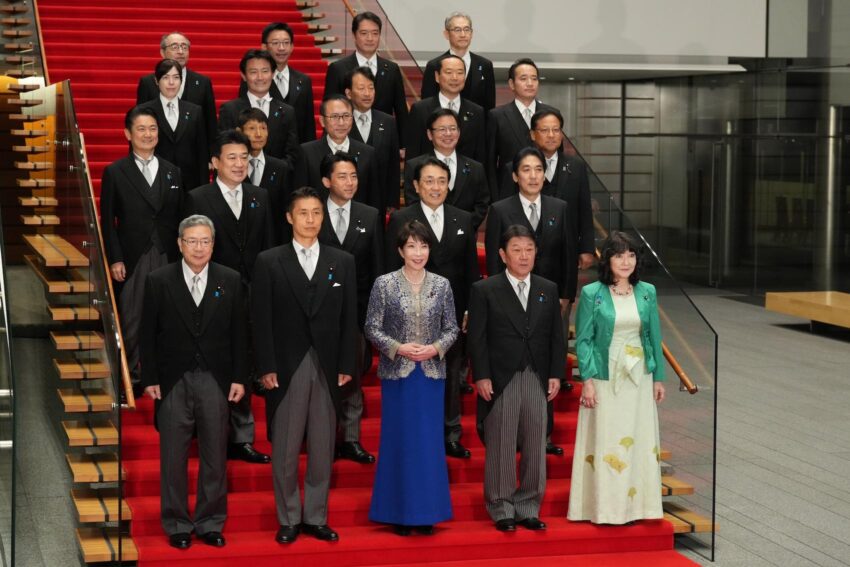
TOKYO — Prime Minister Sanae Takaichi’s cabinet reshuffle on Thursday has effectively kicked off positioning ahead of next year’s contest for the presidency of the ruling Liberal Democratic Party, with a potential rival, Yoshimasa Hayashi, departing both his post as internal affairs minister and the government altogether.
Takaichi kept many influential figures in key positions, in what appears to be an effort to consolidate her power base ahead of the next LDP leadership election — a race she is expected to contest again. Hayashi’s removal stood out as the notable exception to that pattern.
Political analysts suggest Takaichi appears to be prioritizing personal loyalty over broader party unity, while cautioning that she’ll need to show restraint and accountability given the ruling coalition’s commanding majority in the lower house.
The next LDP presidential race is expected in the fall of next year, since Takaichi’s current term as party president runs through September 2027 — covering the remainder of former Prime Minister Shigeru Ishiba’s original three-year term.
A near-total reunion of rivals — minus one
Kentaro Yamamoto, a professor at Kokugakuin University, said Takaichi had been expected to bring her rivals from last October’s leadership contest into the cabinet, forming what he called an “all-encompassing mainstream coalition” ahead of her reelection bid. “But Mr Hayashi was the only exception,” Yamamoto said.
In that earlier race, the conservative Takaichi, 65, faced off against Hayashi, 65 — seen as a moderate voice within the LDP — along with Defense Minister Shinjiro Koizumi, 45, Foreign Minister Toshimitsu Motegi, 70, and LDP policy chief Takayuki Kobayashi, 51. Koizumi and Motegi retained their posts in the reshuffle, joined by other key figures including Chief Cabinet Secretary Minoru Kihara and Finance Minister Satsuki Katayama.
A day earlier, Takaichi had also reappointed Kobayashi, along with LDP Vice President Taro Aso and Secretary General Shunichi Suzuki — Aso’s brother-in-law — to their roles within the party’s executive leadership.
The shadow of Aso’s influence
Following the fallout from a major political slush fund scandal that surfaced in late 2023, the LDP’s internal factions were forced to disband. Aso, an 85-year-old former prime minister, now leads the only faction still standing and continues to wield significant influence within the party.
Takaichi, who has remained unaffiliated with any faction and was initially seen as having a shaky base of support within the LDP, won last October’s leadership contest with Aso’s backing, going on to become Japan’s first female prime minister later that month.
Yamamoto noted that members of the now-dissolved faction once led by former Prime Minister Fumio Kishida — which Hayashi originally belonged to — had split their support between Koizumi and Hayashi during last year’s leadership race, a division Takaichi may have judged posed little threat to her position.
He also pointed to the removal of Junichi Ishii as the LDP’s secretary general in the House of Councillors as part of the broader reshuffle, suggesting it may have sent a signal that those who don’t pledge loyalty could face unfavorable treatment. The LDP-JIP coalition remains a minority in the upper chamber, and Takaichi is reported to have grown frustrated with Ishii over difficulties advancing deliberations on the fiscal 2026 budget, resulting in a strained relationship between the two.
Weakening a potential challenger
Takefumi Ukai, a political theory professor at Seinan Gakuin University in Fukuoka Prefecture, suggested Takaichi may have opted to build a cabinet more closely aligned with her own agenda, rather than retain Hayashi — who could otherwise emerge as a formidable rival.
Removing Hayashi from the internal affairs and communications post may also work in Takaichi’s favor with her coalition partner, the Japan Innovation Party (JIP), which has been actively championing its plan to establish a “second capital” as a backup for Tokyo during disasters or other emergencies. Legislation to create this second-capital system passed parliament in July and was also part of the coalition agreement between the LDP and JIP forged last October — an agreement that helped Takaichi secure the parliamentary vote that made her prime minister.
Buoyed by Takaichi’s popularity, the LDP-JIP coalition went on to score a landslide victory in February’s lower house election, winning well over two-thirds of the seats — the threshold needed to override the upper chamber on legislation.
Ukai suggested the coalition’s ties could deepen further, while Hayashi’s likely strategy would be to distance himself from the government and build public support instead, particularly given that Takaichi’s policies haven’t been universally embraced by the public.
Controversial legislation under Takaichi
Alongside the second-capital project, Takaichi’s government has enacted several other contentious pieces of legislation, including revisions to the Imperial House Law that effectively sidestepped the debate over allowing a woman to ascend to the throne, as well as a law criminalizing the desecration of Japan’s national flag.