
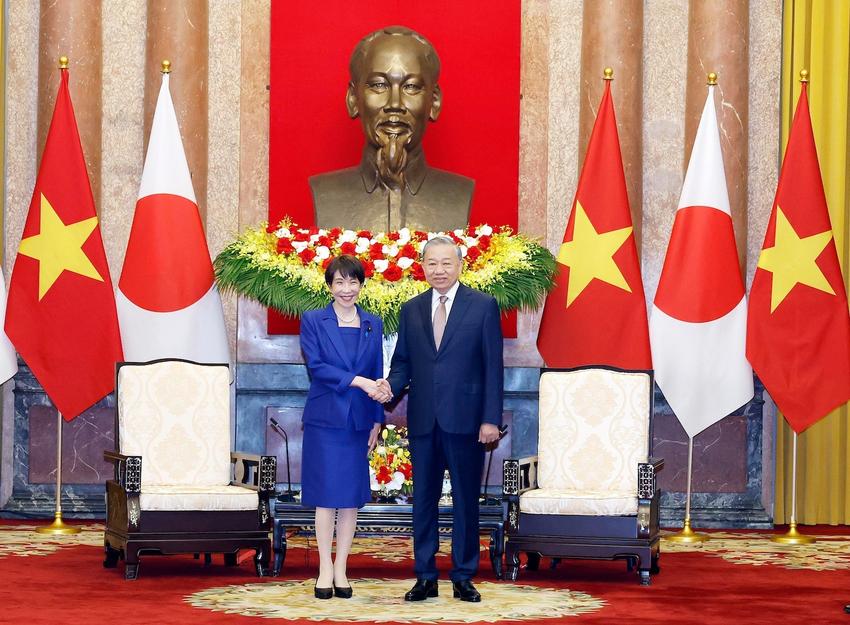
Japanese Prime Minister Sanae Takaichi used a visit to Hanoi on Saturday to reaffirm Tokyo’s commitment to a stable and open Indo-Pacific region, delivering a university address that positioned Japan as a proactive architect of a rules-based regional order.
“I am renewing my determination to play an even more proactive role than ever before in building an international order based on freedom, openness, diversity, inclusiveness, and the rule of law,” she told the audience.
Speaking against the backdrop of what she described as intensifying geopolitical rivalry and rapid technological change, Takaichi called on Asian nations to build resilience and safeguard their ability to chart their own course.
The speech carried unmistakable undertones directed at Beijing, though Takaichi stopped short of naming China explicitly. She cautioned against over-reliance on any single country for essential goods, arguing that artificially suppressed prices often drive such dependence, and stressed the need for equitable conditions in global trade. She also highlighted the critical importance of keeping maritime routes safe and accessible.
The choice of Vietnam as the venue was itself significant. While both Tokyo and Hanoi share anxieties over China’s expansive territorial claims in the East and South China Seas, Vietnam’s long-standing “bamboo diplomacy” — a balancing act aimed at maintaining cordial relations with all major powers — sets it apart from Japan, whose ties with Beijing have grown increasingly strained in recent months.
The Indo-Pacific framework Takaichi championed was originally conceived by her political mentor, the late Shinzo Abe, roughly a decade ago, and has since gained broad traction among Washington’s partners as a counterweight to Chinese influence. Beijing has consistently rejected the initiative, framing it as an effort to engineer bloc-based confrontation. Chinese foreign ministry spokesman Lin Jian renewed that criticism, accusing Tokyo of stoking divisions between competing camps.
Takaichi has long been regarded as a hardliner on China. Her remarks last November — suggesting Japan could intervene militarily to prevent a Chinese takeover of Taiwan — drew a sharp diplomatic response from Beijing, which summoned the Japanese ambassador, discouraged Chinese nationals from travelling to Japan, and introduced trade restrictions.
On the bilateral front, the visit yielded concrete results. Takaichi met with Vietnamese Prime Minister Le Minh Hung and Communist Party General Secretary To Lam, who recently assumed the presidency as well. The two sides agreed to elevate their strategic partnership and signed six cooperation agreements covering technology, climate resilience, and communications infrastructure. They also pledged to deepen security ties and affirmed their shared position that South China Sea disputes must be resolved through peaceful, internationally grounded means.
Japan remains Vietnam’s largest source of official development assistance and a major investor, with bilateral trade surpassing the $50 billion mark for the first time last year.
Takaichi is scheduled to continue her regional tour with a visit to Australia following her departure from Vietnam on Sunday.