
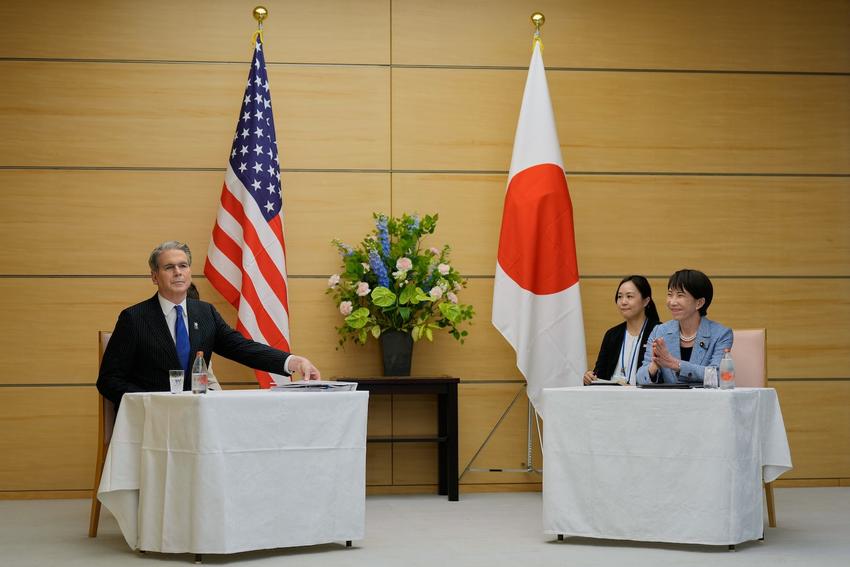
Tokyo—Japanese Finance Minister Satsuki Katayama announced Tuesday that she and U.S. Treasury Secretary Scott Bessent agreed to closely monitor currency market movements following Japan’s recent yen intervention to counter depreciation against the dollar.
The talks, held at Japan’s Finance Ministry, also covered responses to China’s export controls on critical minerals and rising AI-driven cybersecurity risks, just before U.S. President Donald Trump’s two-day summit with Chinese President Xi Jinping in Beijing starting Thursday.
“We are in good coordination regarding recent currency movements” amid Middle East tensions, Katayama told reporters, adding that Japan’s position received “fully supported” backing. Bessent echoed this, stating, “We both believe that excess volatility is undesirable,” and praised the “constant” and “robust” communication between their teams. He added on X that Japan’s economy fundamentals are “strong and resilient,” which should reflect in exchange rates.
Japan intervened on April 30 to halt the yen’s slide toward 160 per dollar amid Middle East-driven safe-haven flows to the USD, with likely further operations during early May’s Golden Week holidays, sources said. The duo reaffirmed a September joint statement reserving interventions for “disorderly depreciation or appreciation” or volatility.
Bessent, visiting ahead of the Trump-Xi meeting, also briefed Prime Minister Sanae Takaichi on U.S.-China ties, Japan’s U.S. investments, and critical mineral supply chains. Takaichi called for deeper finance chief coordination, stronger supply chains, and minimized AI risks, per government statements.
Katayama highlighted China’s “terrible and unfair” export curbs on Japan—tightened amid Taiwan tensions and covering dual-use items like rare earths. The U.S. pledged to press China on this. She warned of AI threats like Anthropic’s Claude Mythos model, which exploits infrastructure vulnerabilities: “China can catch up in six months or a year…the Western side needs to coordinate so that it will not be weaponized by those who are not our allies.”
Other topics included G7 finance chiefs’ Paris meeting next week to cut China reliance on critical minerals. While a weak yen boosts exporters, excessive falls raise import costs for fuel and materials in resource-scarce Japan.
On Bank of Japan policy, Bessent expressed “great confidence” in Governor Kazuo Ueda despite criticism of slow rate hikes post-2024 easing exit. Katayama deferred monetary decisions to the BOJ.
Bessent met Economy Minister Ryosei Akazawa on energy and minerals cooperation, and Foreign Minister Toshimitsu Motegi on economic security and export controls.