
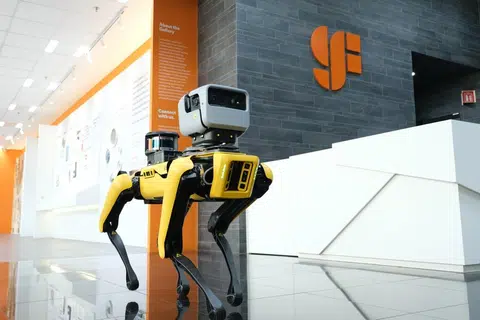
As artificial intelligence moves beyond computer and mobile screens into physical form, chipmakers are focusing more heavily on the hardware and technologies needed to power robots and the infrastructure that supports them.
Humanoid robots, widely seen as the most advanced form of physical AI, are closer to mass production than many realize. To function in the real world, these robots will require purpose-built semiconductor platforms capable of responding in real time and carrying out physical tasks.
At the same time, hyperscale data centres will face unprecedented traffic, which could push bandwidth and power demands to levels their current systems are not yet equipped to handle.
US chipmaker GlobalFoundries (GF), which has a major manufacturing presence in Singapore and recently acquired a local semiconductor company, sees physical AI as the next major wave of innovation and a significant opportunity to deliver energy-efficient, highly integrated chips and devices.
Gregg Bartlett, the company’s chief technology officer, said GF has been working on physical AI and related semiconductor technologies for several years, with the aim of transforming itself from a contract chip manufacturer into a more comprehensive technology provider.
To support that shift, the company has acquired a number of smaller firms for their technology and manufacturing capabilities, including Singapore’s Advanced Micro Foundry (AMF).
The 2025 acquisition expanded GF’s silicon photonics portfolio, production capacity and research and development in Singapore. It also complements the company’s existing capabilities in the US, opening up new market opportunities and helping meet the growing optical communication demands of AI data centres.
Bartlett told The Straits Times: “This is the perfect time for GF to have made these anticipatory investments in intellectual property and capabilities that will fuel this massive ramp-up that’s going to be happening in the next five years.”
The AMF acquisition has made GF the world’s largest pure-play foundry by revenue for silicon photonics, which integrates optical and electronic components onto a single silicon chip and uses light instead of electrical signals for ultra-fast, energy-efficient data transfer.
The move has also strengthened Singapore’s role as a trusted semiconductor manufacturing and innovation hub, and as a critical link in the global chip supply chain.
Bartlett said some early examples of physical AI already exist commercially in autonomous vehicles, drones and robots.
Companies such as Tesla, Boston Dynamics and China’s Unitree Robotics already offer humanoid robots, though these remain limited in number and capability.