
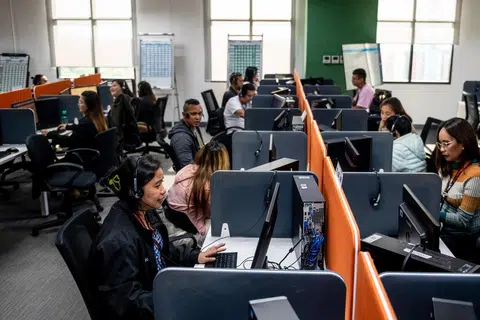
When Mae Caluya looks at the future of the Philippine outsourcing industry—one of the world’s largest—she fears executives like her are in for a rough ride.
The 46-year-old senior director for operations at a call centre in Manila oversees major client accounts and workforce planning. She believes those in management roles are particularly vulnerable.
“The first to go are people like us in management,” Caluya told The Straits Times, noting firms tend to retrench higher-paid executive and senior staff first to cut costs.
US FCC Proposal Threatens Offshore Call Centre Jobs
Her concerns have intensified following a proposal in the US that could make it harder or less attractive for American firms to outsource customer service work overseas, including to the Philippines and India—two of the world’s largest call centre hubs, where millions of jobs and billions of dollars in export earnings are linked to the US market.
The US Federal Communications Commission (FCC) is seeking public comments until June 22 on a proposal made earlier in 2026 to encourage American businesses to take call centre jobs back to the US and improve customer service at existing call centres.
Among the measures being discussed are:
- Ways to encourage and facilitate basing call centres in the US
- Requiring service providers to disclose the location of the call centre during customer interactions
- Requiring call centre workers to be proficient in American Standard English and trained appropriately to resolve US customers’ problems
Protectionist Concerns Raised in Philippines and India
The move, seen by many outside the US as a protectionist non-tariff barrier, has raised concerns in India and the Philippines, where US outsourcing has helped create millions of jobs, increase export earnings, develop a skilled workforce and integrate them deeply into the global economy.
Scale of the Industry:
- Philippines: The business process management (BPM) industry employs about 1.8 million workers and generates roughly US$38 billion (S$49 billion) in annual revenues
- India: The BPM sector’s revenue was estimated at US$59 billion for the financial year ending March 2026
The US is the biggest market for BPM service exports from both countries. Nearly 70% of American companies have outsourced at least one business function to foreign countries, driven by the need to cut costs and increase efficiency.
FCC’s Justification: Jobs, Customer Service, and Security
The FCC argues that outsourcing took jobs away from Americans and created other problems, including:
- Poor customer service due to communication barriers
- Bad actors using legitimate call centre training and infrastructure to defraud Americans, including scammers presenting themselves as legitimate customer support providers
- Risks to privacy, data protection, and national security from offshoring
Industry Leaders Respond
Philippines: Jack Madrid, president and CEO of the IT and Business Process Association of the Philippines (IBPAP), said the organization submitted its position to the FCC in the consultation process and is coordinating closely with Philippine government agencies.
“We are aware of the potential implications on legitimate offshore operations and globally integrated delivery models,” he told ST.
The FCC’s public comment process does not formally solicit input from foreign governments or industry bodies, meaning IBPAP’s submission is a voluntary bid to influence domestic US rule-making that could upend a sector employing millions of Filipinos.
Philippine Government Action: The House of Representatives has adopted a resolution urging the Department of Trade and Industry and Department of Foreign Affairs to engage US counterparts on the matter. Philippine ambassador to Washington Jose Manuel Romualdez said Manila is working with lawmakers and industry stakeholders to seek exemptions for the country.
India: Nasscom (National Association of Software and Services Companies), the apex advocacy group for the Indian IT and BPM industry, argued against “broad location-based restrictions or arbitrary offshore caps.”
“Our view is that the focus should be on distinguishing between trusted providers and bad actors, and not on onshore and offshore delivery,” Shivendra Singh, vice-president and head of global trade development at Nasscom, told ST. “We are fully supportive of any effort that supports consumer protection and anti-fraud objectives, and are willing to collaborate on targeting illegal robocalls and bad actors.”
Singh warned the proposal could lead to forced onshoring, potentially causing cost increases and service quality reductions for American consumers. “Our ask is to create a trusted offshore provider registry,” he added.
Part of Wider US Trend Toward Tighter Oversight
The FCC proposal is part of a wider trend of American legislative proposals, administrative actions and policy initiatives seeking to increase scrutiny of high-skilled immigration programmes and encourage domestic hiring:
- End H-1B Visa Abuse Act of 2026: A bill currently with the House of Representatives seeking to impose a three-year pause on new H-1B visas and cut the annual cap from 65,000 to 25,000
- Indian workers hold the vast majority of H-1B visas, which allow American employers to hire foreign professionals for jobs requiring specialised knowledge. Around seven out of 10 of these visas went to Indians in the US fiscal year ending September 2024
- US Department of Labor proposed rule to change prevailing wage methodologies, which would raise wage levels for various categories of foreign workers, increasing labour costs for employers
“While several of these measures remain proposed and not in force, taken together they reflect a directional shift towards tighter oversight, higher cost structures and increased scrutiny of cross-border service models,” said Singh.
AI May Pose Even Greater Long-Term Challenge
But many industry executives argue that artificial intelligence may pose an even greater long-term challenge to the call centre industry than US protectionist measures.
For Caluya, warning signs appeared long before the latest moves in Washington. She said companies across the sector had already been grappling with declining call volumes, shrinking hiring forecasts and growing pressure from AI tools that can now perform many routine customer service functions once handled by human agents.
“We have noticed a reduction of headcounts,” she said. “The basic customer service accounts are slowly seeing less volume.”
Industry Must Pivot to High-Skill, Value-Added Services
As AI reduces the need for human agents in basic tasks, Prasanto Roy, a Delhi-based technology and public policy consultant, said BPO firms should fully pivot away from selling services merely on the basis of cheap labour to focusing on technology-driven, high-skill and value-added services.
“BPOs must move from their old business model to charging based on what they actually deliver, such as charging for per customer issue resolved, shifting the industry towards performance and value-based pricing models,” he said.
“And they must monetise the AI value chain by building further on it, not fight it,” he added, noting how some Indian BPO firms are shifting their call agents into specialised AI roles such as data labellers, trainers and prompt engineers.
Rebranding Reflects Industry Transformation
In May 2026, the Contact Center Association of the Philippines rebranded itself as the Customer Xperience Association of the Philippines.
This change from “Contact Center” to “Customer Xperience,” Roy said, reflects the “aspirational shift” towards higher-value, AI-enabled services rather than traditional voice-based transactions.