
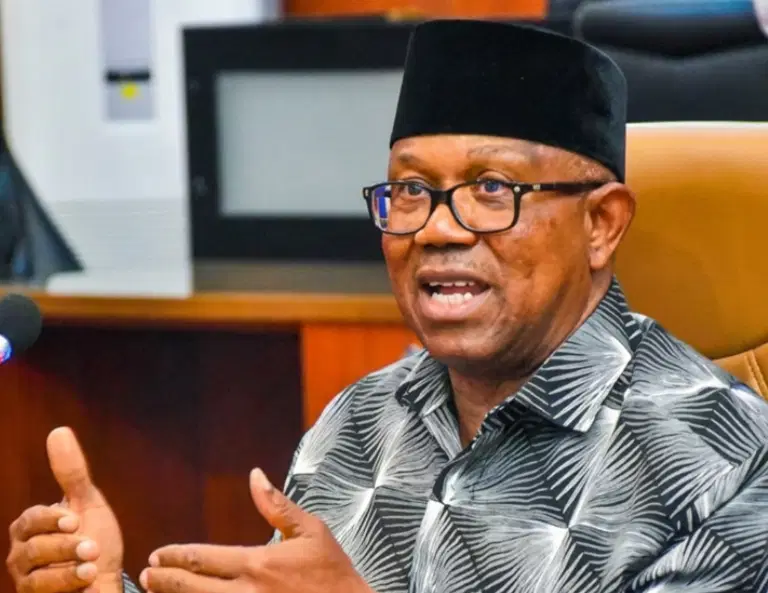
Peter Obi, presidential candidate of the Nigeria Democratic Congress (NDC), has denied asking Nigerians living in the United Kingdom to abandon relatives who depend on them for financial support. He said his remarks about hardship in Nigeria were distorted by political opponents.
In a statement titled “My Message Has Been Twisted”, posted on X on Tuesday, the former Anambra State governor said he deeply appreciates Nigerians in the diaspora who make large sacrifices to support their families at home. He stressed that his concern is the country’s dependence on remittances to meet basic needs.
“I deeply appreciate Nigerians in the diaspora who work tirelessly and make enormous sacrifices to support their families back home,” he said. “Their remittances pay for school fees, hospital bills, rent, and feeding expenses. Their patriotism and sacrifices deserve our profound respect. I never asked them to abandon their loved ones.”
“Not a country where millions depend on relatives abroad”
Obi said his message was meant to draw attention to the economic conditions that force millions of Nigerians to rely on relatives overseas for survival.
“My concern is that Nigeria should not remain a country where millions depend on relatives abroad for basic survival,” he said. “Our goal must be to build a nation that provides jobs, affordable healthcare, quality education, and economic opportunities for its citizens.”
He accused political opponents of misrepresenting his comments, insisting that his position is about addressing the causes of hardship rather than discouraging financial help for families.
“Political opponents may twist my message, but the truth remains clear: I am not asking Nigerians abroad to abandon their families. I am advocating for a Nigeria that will no longer abandon its own people,” he said.
The comments that sparked the row
The clarification followed backlash over remarks Obi made at a town hall meeting with diaspora supporters in Manchester on Sunday. A video of the event went viral, showing him urging Nigerians in the UK to stop handing money to relatives and others at home who ask them for help.
“You have people at home in Nigeria today who are begging you for money. Tell them no!” he said in the video.
Obi blamed the country’s economic difficulties on poor leadership. He urged Nigerians abroad to encourage their relatives and friends back home to vote for leaders who would prioritise productivity and economic opportunities.
Two readings of the same message
The episode shows how a single line can be read in very different ways. Taken alone, “Tell them no!” sounds like a call to cut off family members. Obi’s explanation places it within a wider argument: that sending money home eases individual hardship but leaves untouched the leadership failures he says cause it, and that the real remedy lies at the ballot box.
His critics, however, seized on the clip, and his statement on Tuesday is an attempt to reframe the debate around the problem he says he was raising. It is not clear from the statement whether he regrets the wording of his Manchester remarks, as he did not say so directly.
With the 2027 election drawing near, diaspora supporters are an important audience for candidates, and remittances from Nigerians abroad are a significant source of household income for many families.