
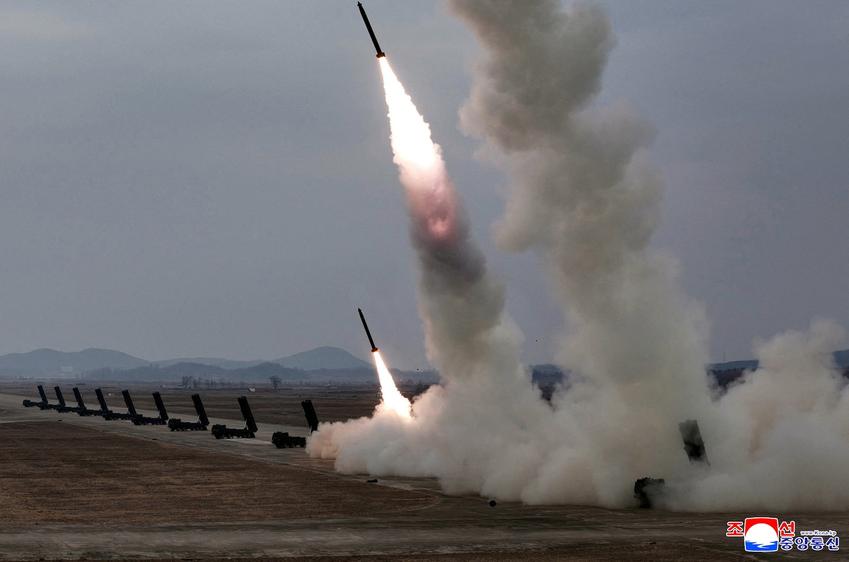
North Korea launched ballistic missiles into the ocean on Sunday, ramping up its testing pace amid escalating Iran conflict and speculation about potential U.S. and South Korean summits.
Experts interpret Pyongyang’s aggressive schedule—this marks the fourth launch this month and seventh in 2026—as a flex of defensive prowess and a bid for diplomatic bargaining power.
“These tests signal that, unlike Iran, we possess robust self-defense options,” noted Kim Ki-jung, a former South Korean presidential security advisor. “North Korea seems to be applying early pressure and staging a power display ahead of possible talks with Washington and Seoul.”
The ongoing seven-week U.S.-Israel campaign against Iran, aimed partly at halting Tehran’s nuclear progress, may fuel Pyongyang’s own atomic goals, according to analysts and ex-South Korean officials.
As U.S. President Donald Trump gears up for a China summit next month, he and South Korean President Lee Jae-myung have voiced openness to dialogue with Kim Jong-un. No formal meetings are confirmed.
Lee recently apologized to the North over South Korean drone flights, earning unusual approval from Pyongyang.
South Korea’s military reported the Sunday missiles originated near Sinpo on the east coast around 6:10 a.m., traveling roughly 140 km into the sea.
Japan’s government shared on social media that the projectiles likely splashed down off the Korean Peninsula’s east shore, with no breach of its economic zone detected.
South Korea’s Blue House held an urgent security huddle, labeling the action a U.N. resolution breach and provocation. It demanded an end to such escalations, per local outlets.
Missile type remains unspecified, though Sinpo hosts submersibles and SLBM testing gear. North Korea’s last sub-launched ballistic missile flew 600 km in May 2022.
IAEA Director Rafael Grossi warned Wednesday of North Korea’s “very serious” nuclear weapon production strides, including a likely new uranium enrichment site.
In late March, Kim Jong-un declared the nation’s nuclear status permanent, stressing the need to bolster its “self-defensive nuclear force” for security.