
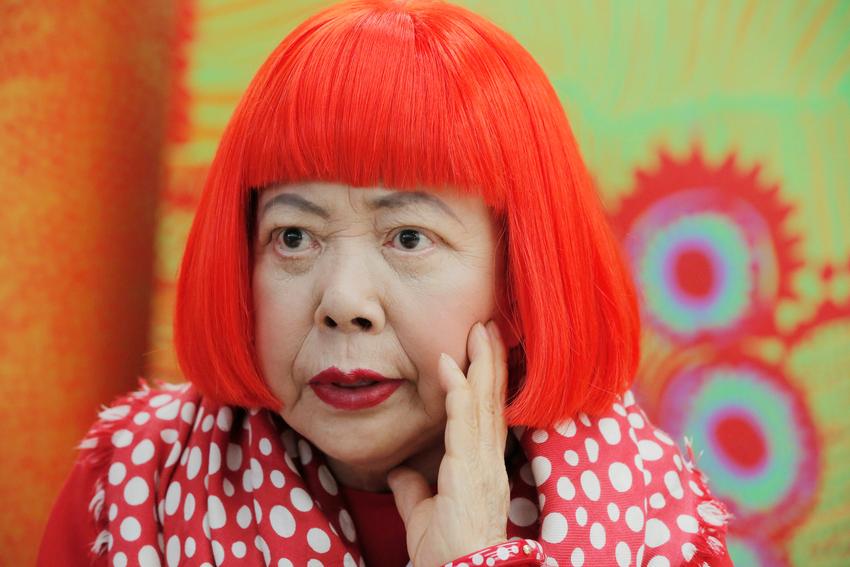
TOKYO — Yayoi Kusama, the Japanese artist celebrated worldwide for her signature polka-dot motifs across paintings, sculptures and museum installations, has died, her studio announced on Thursday. She was 97.
Kusama died on August 14 at a hospital in Tokyo, the Yayoi Kusama Studio said in a statement, noting that she continued painting until her final days and remained devoted to her exploration of love and the eternal soul. The studio said it would carry forward her legacy through art that continues to inspire hope around the world.
One of Japan’s most celebrated contemporary artists, Kusama’s work was exhibited extensively across the globe, including at the Museum of Modern Art and the Whitney Museum of American Art in New York.
Her art was defined by repetitive motifs — netting, swirls, worm-like patterns, and most famously, dots — rendered across canvases and immersive installations in vivid, psychedelic colour. In a 2012 interview with the Associated Press, appearing in her trademark orange bob wig and polka-dot outfit, Kusama described her devotion to the pattern and her determination to keep creating for as long as she could.
Kusama maintained that her art reflected the way she perceived the world, which she said had appeared covered in spots since childhood hallucinations she experienced from an early age. She spent decades in and out of psychiatric care, a struggle that did not prevent her from becoming one of the first Japanese women to relocate to New York to pursue an artistic career, in 1957.
Despite a soft-spoken and shy demeanour, she remained resolute in her artistic vision for decades, eventually bringing her distinctive style to a global mass audience.
Rise to Global Fame
In her later years, as popular culture embraced her aesthetic, Kusama achieved widespread commercial recognition, collaborating with fashion houses including Louis Vuitton and licensing her designs for products ranging from teacups to T-shirts.
In 2008, one of her works sold for $5.8 million at a Christie’s auction. In 2016, she received Japan’s Order of Culture, the country’s highest honour for artists, telling reporters at the time that the recognition strengthened her resolve to continue her artistic pursuits.
Kusama’s work has been variously described as pop art, avant-garde and feminist, though she reportedly resisted being confined to any single category.
Born into a middle-class family that she felt did not understand her artistic ambitions, Kusama left Japan for the United States, arriving in New York during the height of the “action painting” movement, a style far removed from her own. She endured years of financial hardship and limited recognition before her work gained wider acclaim.
Her practice included provocative performance pieces in the late 1960s — including anti-war “happenings” in which she placed paper circles on people’s bodies — that drew both controversy and media attention. During her time in New York, she formed friendships with prominent artists including Andy Warhol, Georgia O’Keeffe and Joseph Cornell.
Among her most notable works are “Macaroni Girl,” a figure covered in macaroni exploring themes around food; “The Visionary Flowers,” large-scale tulip sculptures; and “Mirrored Corridor,” an immersive installation using mirrors and dotted forms.
Kusama, who also worked in film and published several novels, said she was often unable to fully explain the origins of her ideas, describing her creative process as something that surprised even her.
She was known for a complex public persona — by turns declaring herself an “artistic revolutionary” and admitting to persistent private fears — even as she remained a willing and engaging presence in media coverage of her work throughout her career.