
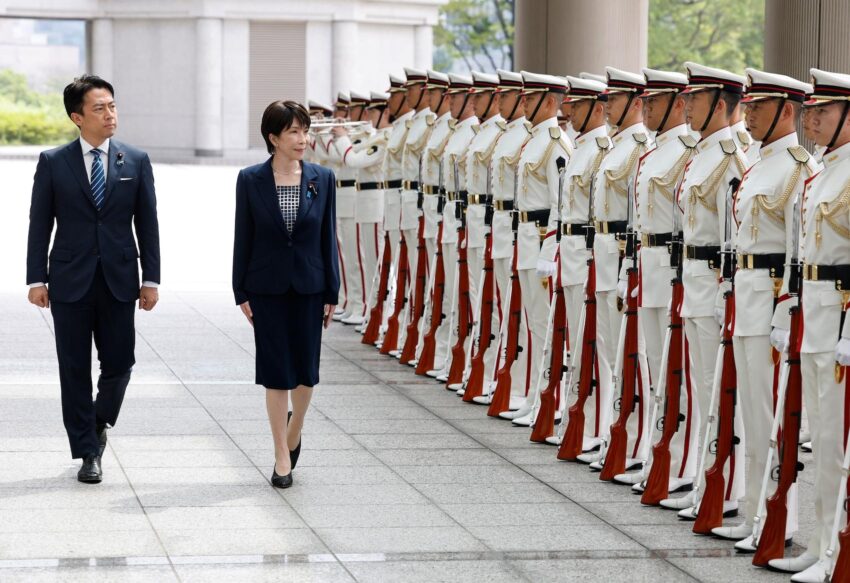
Prime Minister Sanae Takaichi told senior members of the Self-Defense Forces on Wednesday that Japan needs to speed up the use of artificial intelligence and unmanned defense assets ahead of the planned year-end revision of three key national security documents.
“It goes without saying that we should introduce even more speedily” technologies that develop at a completely different pace from traditional equipment, such as AI and unmanned defense assets, Takaichi said as commander in chief of the SDF.
Takaichi said the documents, to be revised less than four years after their previous update in 2022, “will set out a new direction for strengthening defense capabilities,” as the security environment becomes more complex and countries rush to build AI-integrated systems and operate unmanned aircraft on a large scale.
The current National Security Strategy and two other defense-related documents formulated in 2022 were designed to cover the next 10 years, but Takaichi has decided to bring forward their revision to address changes in the security environment, with challenges posed by China and North Korea.
Japan also faces pressure from the administration of U.S. President Donald Trump to increase defense spending.
Earlier this week, the Defense Ministry submitted a record budget request of 8.89 trillion yen ($55 billion) for fiscal 2027 starting April, with plans to develop low-cost attack drones and introduce AI into the SDF’s command structure.
“The activities of the SDF and the fundamental strengthening of defense capabilities that the government is currently pushing forward cannot happen without the understanding and cooperation of the public,” Takaichi said.
She also vowed to improve working conditions for SDF members amid ongoing personnel shortages.
A study group comprising a former top bureaucrat at the Defense Ministry and former senior SDF members at the Sasakawa Peace Foundation, a Tokyo-based nonprofit philanthropic organization, called Wednesday for closer coordination with the private sector.
Areas of cooperation with the private sector have expanded to include the manufacture expanded to manufacturing and maintenance of defense equipment, the operation of communications infrastructure, cyber defense, AI, data analysis and satellites, the groups said in its proposals.
In the previous revision of the security documents, Japan decided to acquire counterstrike capabilities, marking a major shift from its exclusively defense-oriented policy under the war-renouncing Constitution, and set a goal of raising defense spending to the equivalent of 2 percent of GDP.
The meeting of the Defense Ministry and Self-Defense Force Command Personnel was convened for the first time since Takaichi took office in October last year.
It was first held in 1964 and typically convened annually until September 2019, with a remote gathering held in 2020 during the coronavirus pandemic.