
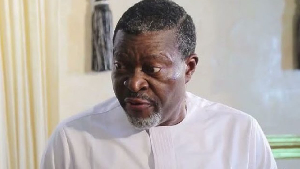
Veteran Nollywood actor Kanayo O. Kanayo has triggered a wave of criticism in Ghana after making a series of blunt comments about Ghanaian women, wealthy people and the country’s film industry during a visit linked to actor LilWin’s upcoming movie project.
The Nigerian star, who arrived in Ghana expecting to work alongside some of Nigeria’s biggest actors, instead found himself at the centre of a heated debate after remarks that many Ghanaians viewed as disrespectful. His comments touched on the familiar Ghana-Nigeria rivalry, but went well beyond the usual arguments over jollof rice and entertainment.
Comments on Ghanaian women
One of the most controversial statements came when Kanayo was asked to choose between Ghanaian and Nigerian jollof rice. Rather than answer directly, he compared the question to a debate about which country’s women were better in bed.
He then claimed that Ghanaian women were “boring in bed,” saying they were less active than Nigerian women. The remarks were widely condemned as demeaning and inappropriate, with many Ghanaians arguing that the actor had crossed the line from playful rivalry into disrespect toward Ghanaian women.
The comment quickly spread across social media, where users accused Kanayo of using his platform to insult Ghanaian women rather than engage in harmless banter.
Wealth and generosity remarks
Kanayo also stirred anger when he claimed that Nigeria had more rich and generous men than Ghana. He argued that the presence of wealthy, willing investors had helped Nollywood grow into a major film industry, while he suggested that Ghana lacked comparable support.
He said some wealthy Nigerian men could lose $20,000 and still remain unconcerned, adding that early Nigerian filmmakers had been able to produce movies using money provided by their husbands. According to him, that level of financial backing did not exist in Ghana, which he blamed for the country’s struggling movie industry.
Many Ghanaians rejected the claim, describing it as an unfair generalisation about Ghana’s wealthy class and an oversimplification of the challenges facing the country’s creative sector.
‘Don’t equate yourself with me’
The actor’s comments on actors’ fees also provoked a strong reaction. Kanayo argued that Ghanaian actors should not expect to earn the same amount as Nigerian stars simply because they appear in the same production.
He said the film industry operates on a hierarchy and that performers should negotiate pay based on their individual standing. In a pointed statement, he referenced his own long career and founding role in Nollywood, telling Ghanaian actors not to concern themselves with what Nigerian actors are paid.
His remarks were interpreted by critics as placing Ghanaian actors beneath him and dismissing their right to fair compensation. While pay differences are common across the entertainment industry, the tone of his comments was seen as condescending.
Challenge to Ghanaian actors
Kanayo further inflamed the debate when he declared that no Ghanaian actor could match him in acting. He called for a direct competition in which he and a Ghanaian actor would each be given a script and asked to demonstrate their talent.
“I want a competition where a Ghanaian actor is given a script, I am given a script, and we meet to exchange our talents,” he said, before adding, “None can stand me.”
Although he framed the challenge as a test of skill, many Ghanaians saw it as a dismissal of the country’s acting talent. Critics argued that experience and seniority should not be used to belittle other performers, especially during a visit intended to promote collaboration between the two industries.
Growing Ghana-Nigeria tension
The controversy has reignited discussions about the relationship between Ghana and Nigeria, particularly in the entertainment space. While the two countries share a long history of cultural exchange and collaboration, remarks perceived as disrespectful often provoke strong national reactions.
Kanayo’s comments have placed him at the centre of that tension, with many Ghanaians calling for him to apologise. Others have defended parts of his argument about industry hierarchy and investment, but agree that his delivery was unnecessarily provocative.
As the debate continues, the actor’s visit has become less about his work on LilWin’s movie and more about the wider conversation over respect, collaboration and the standing of Ghanaian talent within Africa’s film industry.