
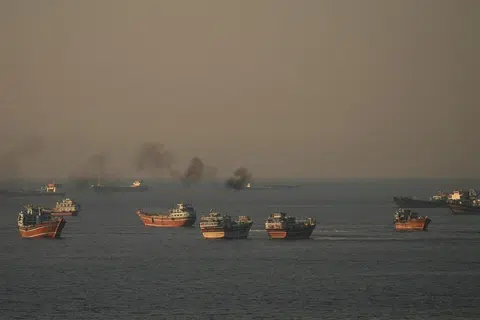
Iran’s Islamic Revolutionary Guard Corps said on June 20 that the Strait of Hormuz was closed to vessel traffic, warning that the security of vessels would be at risk if they approached the waterway.
Iran’s top joint military command, the Khatam al-Anbiya Central Headquarters, had earlier cited alleged violations of a ceasefire agreement by the US and Israel as the reason for the move.
It said that the closure was the “first step” in response to what it described as breaches of commitments and warned that further measures would be taken if “aggression” continued.
Israeli strikes killed at least 16 people in Lebanon on June 20, hours after a truce took effect, with Israel saying it was reacting to attacks from Hezbollah and the Iran-backed group saying it would not allow Israel “freedom of movement” in Lebanon.
A halt to the fighting in Lebanon is a condition for starting 60 days of US-Iranian talks to resolve disputes over Iran’s nuclear programme and other thorny issues key to forging a more durable deal to reopen the Strait of Hormuz and stabilise global oil supplies.
It was not clear when those talks might get under way.
The June 17 interim US-Iran deal requires both countries and their allies to stop military operations on all fronts, including in Lebanon
Lebanon’s state news agency NNA said Israeli warplanes and drones had on June 20 struck locations across southern Lebanon and the Bekaa Valley, both strongholds of Hezbollah.
Lebanon’s Civil Defence service said 16 people were killed in the raids.
An Israeli military official said Hezbollah had fired more than 50 projectiles at Israeli forces in southern Lebanon overnight, and that Israel had attacked what it described as Hezbollah targets in response.
A military statement added that Israel was committed to the ceasefire and would continue to act against any threat to the country or its forces.
A Hezbollah statement said its fighters had confronted Israeli forces trying to infiltrate the Ali al-Taher hill area in southern Lebanon overnight, and had inflicted casualties.
A senior Hezbollah official told Reuters the group would not allow Israeli forces freedom of movement in Lebanese territory.
The Hezbollah statement said the group remained committed to the ceasefire but would respond to any attempt by Israel to seize territory or expand its occupation.
Lebanon was sucked into the regional war when Hezbollah attacked Israel after the latter and its ally, the US, began their war on Iran. Israel responded with an offensive against Hezbollah that included invading southern Lebanon.
One of the deadliest Israeli strikes on June 20 hit a three-storey residential building in the town of Barish in the Tyre district, killing a couple and their two children, a town official said.
The Lebanese army said an Israeli strike also killed a soldier on the Kfarrumman-Nabatieh road.