
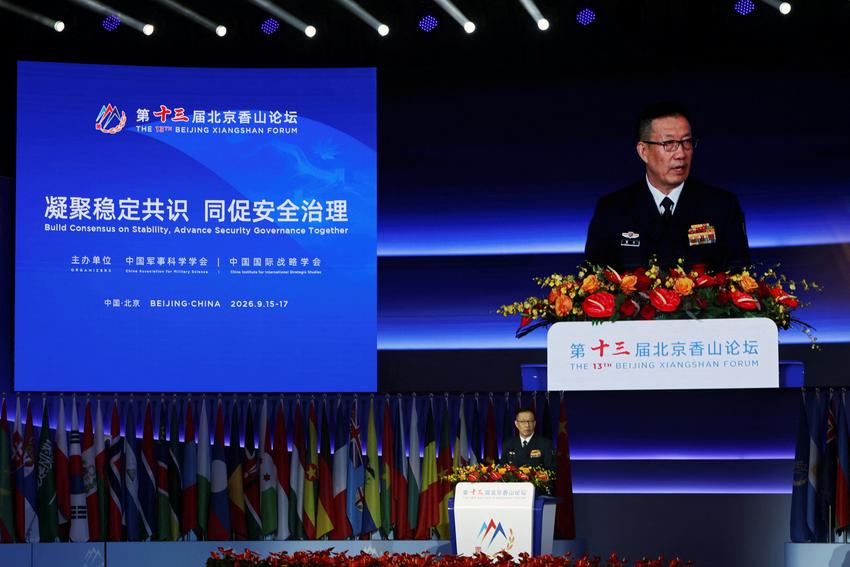
Chinese Defence Minister Dong Jun called on Wednesday for nations to avoid provocative behaviour and resist what he described as a resurgence of regressive historical trends, in remarks widely interpreted as an indirect criticism of Japan.
Dong made the comments in an opening address at the Beijing Xiangshan Forum, an annual security conference, amid heightened regional tension over Taiwan and the disputed South China Sea, and growing uncertainty over the durability of traditional U.S. security commitments in Asia.
Describing the current period as a “fragile moment,” Dong called for a more equitable approach to resolving international disputes, though he offered few specifics and stopped short of naming any country directly. He said nations must remain vigilant against manifestations of hegemony, militarism and historical revisionism, and should not tolerate or ignore such behaviour, adding that “broad-based forces of justice” must work to suppress its resurgence.
Backdrop: China-Japan tensions
Relations between Beijing and Tokyo deteriorated sharply last year after Japanese Prime Minister Sanae Takaichi suggested that a hypothetical Chinese attack on Taiwan could prompt a Japanese military response. China has since repeatedly accused Japan of drifting toward its pre-war militarist posture, a reference to the Japanese occupation of Manchuria in 1931 and the subsequent war between Japan and the then-Republic of China.
No direct criticism of Washington or its allies
Dong avoided direct criticism of the United States or its regional allies, including Japan, and largely reiterated established Chinese positions. He called for a peaceful, multipolar international order built on partnership rather than alliance and mutual benefit rather than zero-sum competition, and said countries should collectively resist provocative acts undertaken for narrow national or factional gain.
The remarks came roughly a week ahead of an expected visit to the United States by Chinese President Xi Jinping for a summit with President Donald Trump. China regards Taiwan, which is self-governing and rejects Beijing’s sovereignty claims, as its own territory, and has increased military pressure around the island in recent years, including periodic military exercises.
A rival forum, and sharp words between Saudi and Iranian delegates
The Xiangshan Forum, often characterised as a more tightly controlled counterpart to Singapore’s Shangri-La Dialogue, is being attended by roughly 2,000 military officers, diplomats and academics from 100 countries over three days, including regional defence ministers, a senior Pentagon official, Russian academics and Taliban representatives. The gathering coincides with an expansion of Chinese military diplomacy, including bilateral exercises that observers say have grown more complex over time.
One notable exchange occurred during a panel featuring Saudi researcher Prince Turki Al-Faisal and senior Iranian military officer Mohammad Taghi Osanlou. Osanlou accused the United States of attempting to preserve a “unipolar hegemonic system” against the broader current of history, and said external powers were undermining unity in the Middle East. Al-Faisal, while also criticising the United States and Germany, said Saudi Arabia’s immediate concern was Iran’s failure to respect the sovereignty of Arab states, citing what he described as Tehran’s aggressive and unlawful attacks on Arab territory and assets during the recent war.