
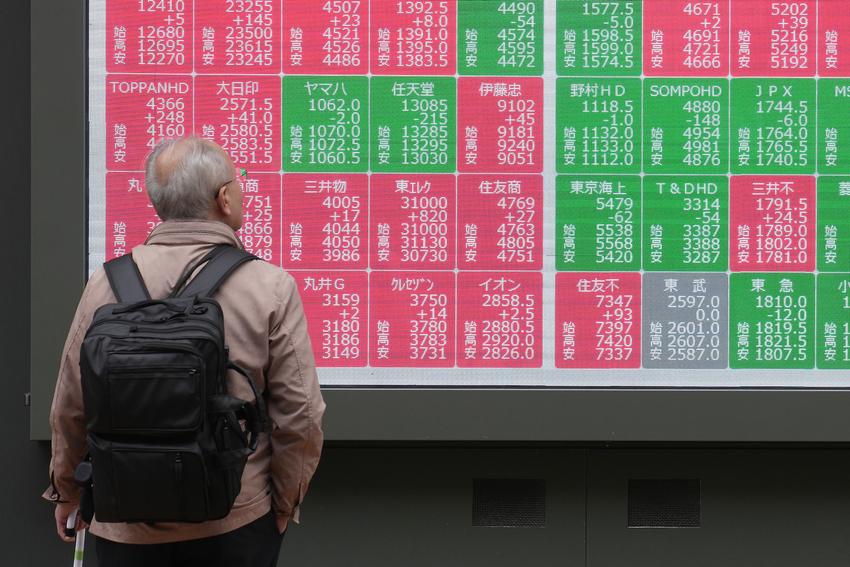
Asian stocks rise as anticipation of a Fed rate drop boosts Wall Street.
After U.S. equities surged on Tuesday due to expectations that the Federal Reserve will shortly lower interest rates, most Asian markets saw gains.
After reopening from a holiday, Tokyo’s Nikkei 225 was trading at 48,642.81, up less than 0.1%.
The Kospi increased 0.3% to 3,859.12 in South Korea. Taiwan’s Taiex increased 1.5%.
Chinese markets improved as well. The Shanghai Composite index increased 0.9% to 3,872.45 in Hong Kong, while the Hang Seng increased 0.4% to 25,821.47.
Alibaba, the massive online retailer that was scheduled to release its earnings late on Tuesday, saw a 1.6% increase.
Australia’s S&P/ASX recovered to close at 8,537.00, up 0.1%.
Due to the Thanksgiving holiday, U.S. markets will be closed on Thursday. The hustle and bustle of Cyber Monday and Black Friday begins a day later.
The U.S. stock market rallied on Monday, at the start of a week with shortened trading because of the Thanksgiving holiday.
The S&P 500 climbed 1.5% to 6,705.12 in one of its best days since the summer. The Dow Jones Industrial Average rose 0.4% to 46,448.27, and the Nasdaq composite jumped 2.7% to 22,872.01.
Stocks got a lift from rising hopes that the Fed will cut its main interest rate again at its next meeting in December, a move that could boost the economy and investment prices.
The market also benefited from strength for stocks caught up in the artificial-intelligence frenzy. Alphabet, which has been getting praise for its newest Gemini AI model, rallied 6.3% and was one of the strongest forces lifting the S&P 500. Nvidia rose 2.1%.
Monday’s gains followed sharp swings in recent weeks, not just day to day but also hour to hour, caused by uncertainty about what the Fed will do with interest rates and whether too much money is pouring into AI and creating a bubble. All the worries are creating the biggest test for investors since an April sell-off, when President Donald Trump shocked the world with his “Liberation Day” tariffs.
The S&P 500 is still within 2.7% of its record established last month, despite all the current anxiety.
This week will see a number of market tests. The U.S. government will release data on wholesale inflation in September on Tuesday, which will be one of the largest.
According to economists, prices will have increased by 2.6% from a year ago, just like they did in August. Since lower rates might exacerbate inflation, a higher-than-expected number may prevent the Fed from lowering its primary interest rate in December for the third time this year. Because inflation has persistently stayed above their 2% objective, some Fed members have already argued against a December decrease.
Traders are nevertheless betting on a nearly 85% probability that the Fed will cut rates next month, up from 71% on Friday and from less than a coin flip’s chance seen a week ago, according to data from CME Group.
In other dealings early Tuesday, U.S. benchmark crude oil lost 25 cents to $58.59 per barrel. Brent crude, the international standard, shed 30 cents to $62.42 per barrel.
The dollar fell to 156.70 Japanese yen from 156.91 yen. The euro slipped to $1.1517 from $1.1521.
Bitcoin fell 1.1% to $88,100. It was near $125,000 last month.