
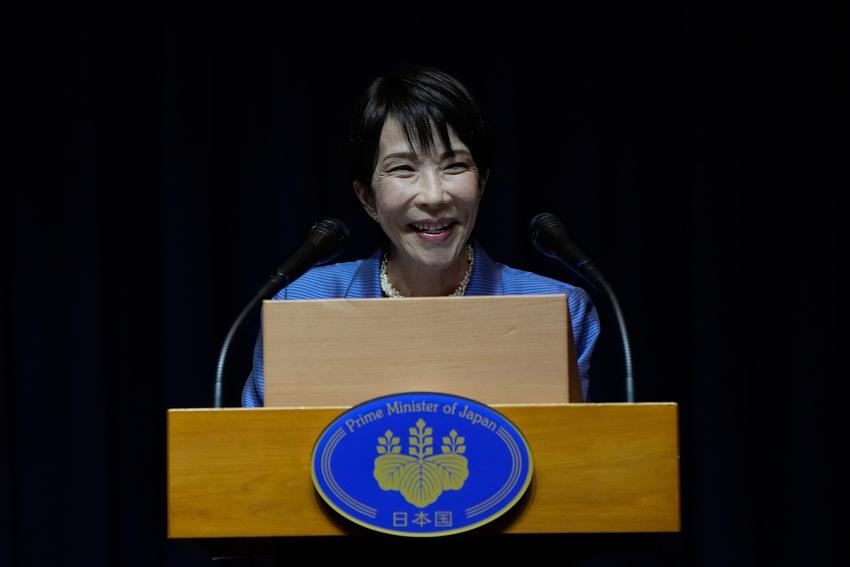
Offhand remark, symbolic suit signal long winter for Japan-China ties
An off-the-cuff remark by new Prime Minister Sanae Takaichi that triggered Japan’s biggest bust-up in years with powerful neighbor China was not meant to signal a new hardline stance.
But after openly stating how Japan might react to a hypothetical Chinese attack on Taiwan, she will struggle to defuse a dispute that could hammer the economy, two government officials with knowledge of the matter said.
China has shown its displeasure with steps designed to inflict pain on the world’s fourth largest economy after Takaichi’s response, which officials said was unscripted, to an opposition lawmaker’s query in her first parliamentary grilling.
These range from a boycott on travel to a halt on imports of its seafood and cancellations of meetings and cultural events.
But Takaichi cannot satisfy Beijing’s core demand to retract her comment that an attack on Taiwan, the democratically-governed island claimed by Beijing, could bring a military response from Tokyo, the officials said.
“It would have been better not to say it, but it’s not incorrect,” said one of the officials, who both sought anonymity as the matter is a sensitive one. “We can’t retract it.”
Opinion polls suggest the comments have not damaged Takaichi’s robust popularity at home, however.
Her “remarks do not change the government’s existing position,” a spokesperson for her office said, adding, “Japan remains open to various forms of dialogue between the two countries.”
China’s foreign ministry did not immediately respond to a request for comment.
LONG WINTER AHEAD
Until now, Japanese leaders had avoided mention of Taiwan in public discussion of such scenarios, hewing to a strategic ambiguity also favored by Tokyo’s main security ally, the United States.
“Takaichi inadvertently boxed herself in and there really is no immediate off-ramp,” said Jeremy Chan, a senior analyst for Northeast Asia with political risk consultancy Eurasia Group.
A former U.S. diplomat who worked in both China and Japan, Chan said there could be a “long winter” in ties between Asia’s top two economies lasting through Takaichi’s premiership.
Beijing has already ruled out a potential icebreaker meeting between Takaichi and China’s Premier Li Qiang on the sidelines this weekend of a meeting of the G20 grouping in South Africa.
Some analysts liken the rift to one triggered by Tokyo’s 2012 decision to nationalize disputed islands that unleashed mass anti-Japan protests across China. Leaders did not meet for 2-1/2 years during that dispute.
“If the current downturn in relations drags on as it did then, the economic damage to Japan would be substantial,” said Takahide Kiuchi, executive economist at Nomura Research Institute.
China’s travel boycott alone could cost Japan more than $14 billion in losses each year, he estimated.
The bigger fear is that China throttles the supply of critical minerals used in items from electronics to cars, the Japanese government official said.
Despite Japan’s efforts to diversify, China still supplies around 60% of its imports of rare earths, macroeconomic research firm Capital Economics estimates.
A broader boycott of Japanese goods in China, as seen in 2012, could bring a loss in sales equivalent to about 1% of Japan’s GDP and hammer its key automotive industry, said Marcel Thieliant, the firm’s Asia head.