
LDP-Japan Innovation Party marriage of convenience may face rocky future
Following the historic coalition deal between the Liberal Democratic Party and the Japan Innovation Party, unease is growing within both over the new partnership, despite it likely delivering the country its long-awaited first female prime minister.
Some JIP members remain cautious, wary of past experiences in which the LDP broke policy agreements. That, combined with a shortage of experienced personnel, means the Osaka-born party has decided to confine its role to cooperation outside the Cabinet.
Within the LDP, now led by conservative Sanae Takaichi, who was elected on Oct 4, some lawmakers are puzzled by the coalition agreement, given that the party called Nippon Ishin has been its rival in Osaka Prefecture constituencies under Hirofumi Yoshimura, the party’s leader for more than a decade.
“What makes the situation difficult is that Ishin is not only a national political party but also a regional one, with its power base centered in Osaka,” said Tatsuhiko Yoshizaki, chief economist at the Sojitz Research Institute.
Nippon Ishin has experienced growing pains as it has evolved into a national force, prompting frequent “uprisings” and internal power shifts among those responsible for Japan-wide affairs, he said.
“Whether Ishin can ensure smooth policy management within the ruling coalition remains uncertain,” added Yoshizaki, who has long had close ties with lawmakers.
The LDP-Ishin coalition was necessitated after the Komeito party, backed by Japan’s largest lay Buddhist organization, Soka Gakkai, decided on Oct 10 to end its 26-year relationship with the LDP.
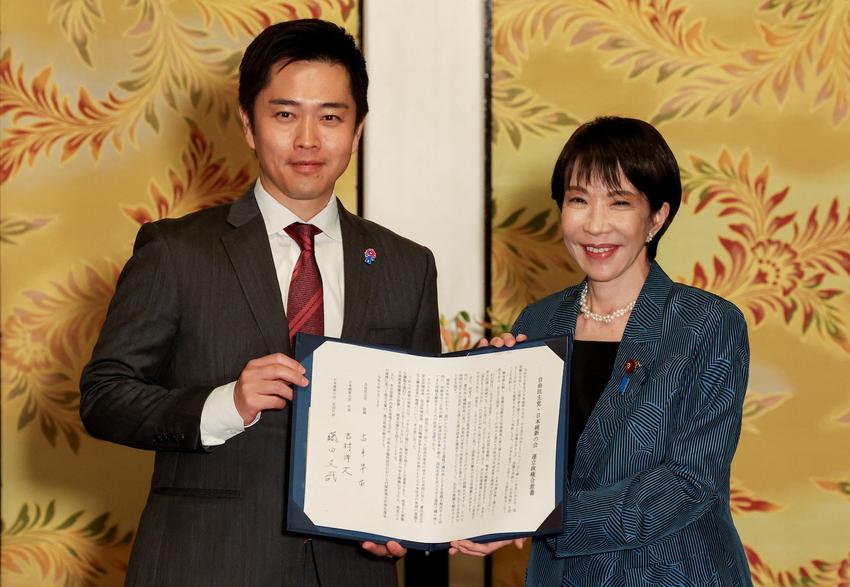
On Monday, Takaichi and Yoshimura signed a coalition agreement less than a week after their parties began policy talks. Yoshimura’s party plans to support the LDP after the two sides reached a broad consensus on key areas such as foreign and security policy.
But a veteran Ishin member said, “We were deceived once by the LDP. We shouldn’t give up everything from the start.”
Yoshimura’s party still recalls the bitter experience of 2024 when the LDP delayed a promised reform of the system providing research, campaigning and accommodation allowances to lawmakers, despite a written agreement, contributing to a reshuffle in Ishin’s upper echelons.
In their policy talks last week, Ishin presented the LDP with 12 requests, including challenging proposals such as cutting parliamentary seats by 10 percent, reducing the consumption tax on food to zero, and banning corporate and organizational political donations.
It is unclear whether all can be realized. If the LDP demonstrates firm commitment to carrying out the policies, Ishin envisions a scenario in which it may consider entering the Cabinet at a later stage, according to party sources.
A lack of seasoned personnel has also posed an obstacle. Founded in the early 2010s, Ishin has many younger lawmakers but few with experience in Cabinet or as local government heads, except those who joined from other parties.
Analysts warn that this experience deficit could lead to missteps in parliamentary responses or addressing future challenges, potentially undermining the new coalition’s credibility and causing friction with Takaichi’s LDP.
Concern is also growing among LDP members in Osaka who are fearful that the new alliance could lead to clashes on regional policy.
Yoshimura has urged Takaichi to fulfill one of his party’s cherished goals, long opposed by the LDP.
Ishin has pursued the “Osaka metropolis plan,” the party’s signature policy aimed at ending the concentration of power in Tokyo. The LDP opposed the proposal in two local referendums in 2015 and 2020, and voters rejected it.
Recently, the Osaka-centric party has advocated a “second capital” initiative to back up Tokyo at times of emergency. Yoshimura argues the metropolis plan is the “minimum requirement” for turning Osaka into a second capital by reorganizing it into an urban hub akin to Tokyo.
If discussions on the second capital initiative gain momentum, debate over the metropolis plan could resurface, possibly inflaming tensions between the parties and hindering talks on other policies.
An LDP official in Osaka Prefecture said, “There will certainly be opposition” in their party if the metropolis plan and the second capital initiative are taken up together.
There are also concerns that the coalition could be hindered by policy paralysis. On monetary policy, in particular, Takaichi, a fiscal dove who is open to expansive issuance of deficit-covering bonds, and Yoshimura take considerably different approaches.
Takahide Kiuchi, executive economist at the Nomura Research Institute, said, “Ishin fundamentally emphasizes fiscal discipline and respect for the Bank of Japan’s independence, in contrast to Takaichi’s stance.”
“Ishin may make some concessions to Takaichi on economic policy, but she is likely to be forced to make compromises of her own,” said Kiuchi, a former BOJ board member.
Whats up very cool web site!! Guy .. Beautiful .. Amazing .. I will bookmark your web site and take the feeds additionallyKI am glad to search out so many useful info right here in the put up, we’d like develop more strategies on this regard, thank you for sharing. . . . . .