
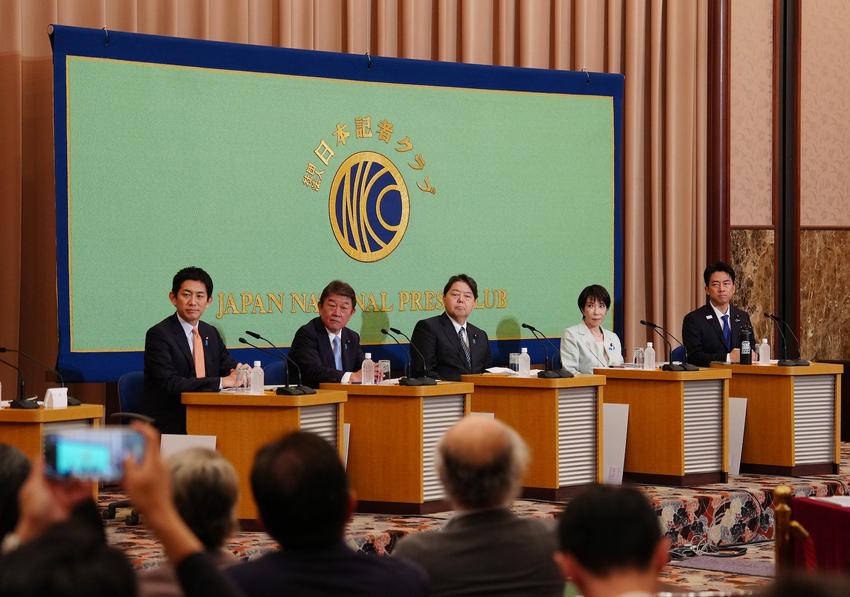
LDP leadership candidates at odds over how to tackle China threat
On Wednesday, the five candidates for the leadership of the ruling Liberal Democratic Party disagreed on how to address China’s security challenges, with one suggesting that Japan should enact an anti-espionage law as a deterrent.
However, all of the contenders for the position of prime minister expressed a deep feeling of crisis over Japan’s deteriorating security situation, pointing to the difficulties presented by North Korea, China, and Russia.
During a joint press conference, the majority of them stressed the need for communication with China while expressing a desire to deepen relations with similar-minded nations including South Korea, Japan’s neighbor, and the United States, Japan’s close security ally.
However, after the general election in October 2024, the LDP-led ruling coalition with its junior partner, the Komeito party, lost control of the House of Representatives, meaning that the next LDP chairman is not guaranteed to become prime minister.
One of the leading candidates in the LDP contest, former internal affairs minister Sanae Takaichi, stated that if she were elected prime minister, she would work to strengthen ties with South Korea in order to cope with North Korea, China, and Russia.
As for the war-related Yasukuni shrine in Tokyo, which is seen by China and South Korea as a reminder of Japan’s historical militarism, Takaichi stated that she would “make an appropriate judgment” if elected prime minister.
Known for embracing the hawkish security views of assassinated former Prime Minister Shinzo Abe, Takaichi added that visiting the shrine, which honors convicted war criminals along with millions of war dead, “must never become a diplomatic issue.”
Farm minister Shinjiro Koizumi, son of former Prime Minister Junichiro Koizumi, pledged to hold a summit with U.S. President Donald Trump “as early as possible,” saying that reaffirming how essential the two longtime allies are to each other would be key.
Takaichi, 64, is seeking to become Japan’s first female prime minister, while Koizumi, 44, whose efforts to address surging rice prices have drawn public attention, is aiming to take the helm at the youngest age in the postwar era.
Relations between Japan and South Korea, often strained over wartime history and other issues, have improved drastically in recent years, due in part to mounting concerns over China’s intensifying military activities.
Nevertheless, South Korea and China have criticized visits to Yasukuni by Japanese politicians, including Takaichi and Koizumi. Japan invaded large parts of China before the end of World War II and colonized the Korean Peninsula from 1910 to 1945.
The LDP presidential vote is scheduled after Prime Minister Shigeru Ishiba abruptly announced earlier this month his intention to step down, taking responsibility for the ruling bloc’s loss of a majority in the July 20 House of Councillors election.
Campaigning for the race officially kicked off Monday, with Takaichi, Koizumi, former economic security minister Takayuki Kobayashi, former Foreign Minister Toshimitsu Motegi and Chief Cabinet Secretary Yoshimasa Hayashi declaring their candidacies.
On Wednesday, Kobayashi, 50, said Japan’s current goal of raising defense spending to 2 percent of gross domestic product is “insufficient,” but stopped short of citing specific targets such as NATO’s 3.5 percent benchmark.
He lambasted China’s unilateral attempts to change the status quo in the East and South China seas, while noting the repeated detention of Japanese nationals on spying charges in China, warning that the risks “will persist.”
Motegi, 69, once described by Trump as a “tough” negotiator, said Japan should highlight its role as the most important partner of the United States in countering China, which he called Washington’s “biggest challenge.”
Hayashi, 64, often portrayed as pro-China, said Japan needs to manage its ties with the United States on the assumption that future U.S. administrations may adopt policies similar to Trump’s unilateral and protectionist approach, already affecting trade and security.
Regarding defense, Hayashi referred to the drafting of Japan’s national security strategy designating China’s behavior as the nation’s “greatest strategic challenge” to respond to Beijing’s growing assertiveness and maintain stability in the region.
All five candidates expressed understanding of the Japanese government’s decision not to recognize Palestinian statehood, in line with the United States.