
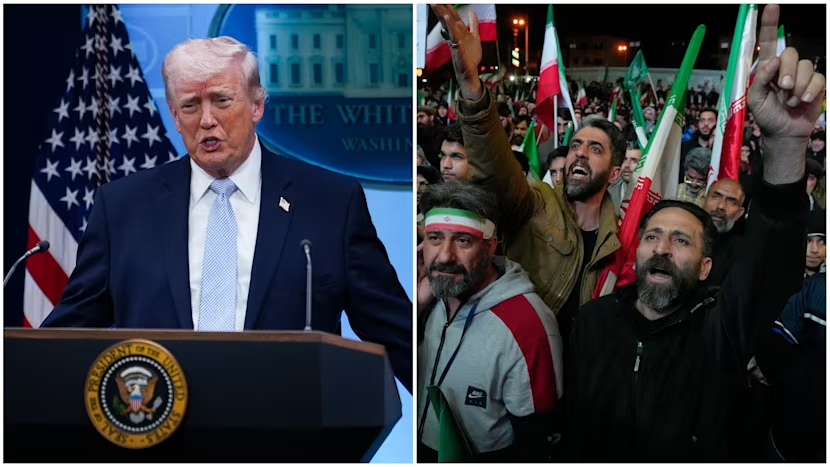
Trump and Iran agree to two-week ceasefire and reopening of Strait of Hormuz
Donald Trump has agreed to suspend the “destructive force” he previously threatened against Iran, announcing a two-week ceasefire aimed at reopening the Strait of Hormuz, a critical global oil route.
In a post on Truth Social, Trump described the agreement as a “big day for World Peace,” adding that the United States would assist in easing traffic through the strait, which has remained largely closed during the ongoing conflict. The ceasefire was announced shortly before Trump’s deadline for Iran, with the waterway, through which about a fifth of the world’s oil supply passes, having been effectively blocked over the past month.
Trump said Iran had proposed a “workable” 10-point peace plan to help end the war, although he later described the same plan as fraudulent without providing further details. He stated that the decision to suspend military action followed discussions with Shehbaz Sharif and Asim Munir, who urged restraint, contingent on Iran agreeing to the immediate and safe reopening of the strait.Benjamin Netanyahu confirmed that Israel had accepted the ceasefire proposal but clarified that it would not apply to ongoing hostilities involving Hezbollah in Lebanon.
This position was contradicted by Pakistan, which played a mediating role in the agreement, with its leadership indicating that the ceasefire should include a halt to fighting in Lebanon. Following the announcement, UK Prime Minister Keir Starmer welcomed the development and said he would travel to the Middle East to support implementation efforts and visit British troops in the region.
Iran’s Supreme National Security Council confirmed acceptance of the temporary ceasefire and indicated readiness to begin negotiations with the United States in Islamabad. Foreign Minister Abbas Araghchi stated that passage through the Strait of Hormuz would be permitted for the duration of the ceasefire under Iranian military oversight.
It remains unclear whether Iran will fully lift restrictions on the waterway, though reports suggest both Iran and Oman may impose transit fees on vessels, with Iran expected to use the revenue for reconstruction.
Iran’s broader conditions for ending the conflict reportedly include the withdrawal of US forces from the region, the lifting of sanctions, and the release of frozen assets. Despite the ceasefire announcement, attacks were reported across Israel, Iran, and parts of the Gulf region early Wednesday, raising uncertainty about the agreement’s immediate effectiveness.
Confusion also emerged over the details of Iran’s proposed peace plan, with discrepancies between Farsi and English versions. The Farsi version reportedly included a clause on the “acceptance of enrichment” for Iran’s nuclear programme — a point omitted in English translations — complicating negotiations, as the United States and Israel have consistently demanded a complete halt to Iran’s nuclear activities.