
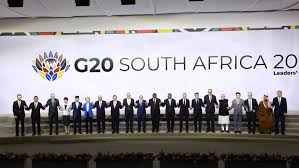
G20:The G20 Summit: A new era for Africa in global affairs
The 20th Group of Twenty (G20) Summit opened here Saturday under the theme “Solidarity, Equality and Sustainability,” marking its first-ever gathering in Africa and underscoring the Global South’s rising role in global governance.
World leaders gathered for the two-day summit to address pressing global challenges amid sluggish economic recovery, rising geopolitical tensions and widening development gaps, despite the United States’ decision not to participate.
With participants expected to build consensus on promoting multilateralism, the Johannesburg summit is seen as an opportunity to inject new momentum into global governance reform.
Since the African Union (AU) became a permanent member of the G20 in 2023, and now with the summit making its historic debut in Africa, the continent is shifting its role on the world stage, moving from decades of marginalization in the global agenda to an influential voice in international affairs.
Since assuming the G20 presidency last December, South Africa has hosted over 130 meetings at various levels, amplifying voices from across Africa and the broader Global South.
The world requires more solidarity, equality and sustainability, Chrispin Phiri, a spokesperson of South Africa’s Department of International Relations and Cooperation, told Xinhua at the media centre of the summit.
“That is what this G20 conference is about, and what we want to see this summit as a whole addressing for other African countries as well,” he said.
Against the backdrop of profound changes unseen in a century, the urgency for global governance reform has grown sharper than ever, with the Global South speaking with a stronger, more unified voice.
Ramaphosa called for upholding multilateralism at the summit, noting that the challenges facing all nations today can only be addressed “through cooperation, collaboration and partnership.”
During the meeting with Ramaphosa on the eve of the summit, Chinese Premier Li Qiang expressed China’s readiness to work with South Africa to enhance coordination within the G20 and at other multilateral platforms, uphold the multilateral trading system, promote reform of the global governance system, and safeguard the common interests of developing countries.
Having evolved from a forum centred largely on broad macroeconomic issues, the G20 now engages with a far wider agenda, including sustainable development, science and technology, agriculture, energy, and climate and environmental action, among other priorities, playing a stabilising role in global governance.
This year’s summit presents a valuable opportunity to push forward long-needed reforms and promote a fairer, more inclusive governance, with the emphasis on four priority areas, including strengthening disaster resilience and response, promoting debt sustainability for low-income countries, mobilising finance for a just energy transition, and harnessing critical minerals for inclusive and sustainable growth.
“As Africa implements these continental strategies, we remain firmly committed to multilateralism and reiterate our strong call for reforms to the International Financial Architecture, reaffirming our full support for strengthening the rules-based global trading system, particularly through ongoing reform processes at the World Trade Organization,” said Angolan President and Chair of the AU, Joao Lourenco, during the summit.
On Friday, United Nations Secretary-General Antonio Guterres told reporters ahead of the summit that the G20 can help drive reforms that give developing countries, and Africa in particular, a real voice in shaping global policies, and make global economic governance more inclusive, representative, equitable and effective in the years ahead.
Similar to the Chinese vision of building a community with a shared future for humanity, Africa’s Ubuntu philosophy, which means “I am because we are,” holds that no one should be left behind.
Last year, at the 2024 Summit of the Forum on China-Africa Cooperation, President Ramaphosa noted that the 10 partnership action plans proposed by China are all in line with the AU’s Agenda 2063, which reflected the shared desire for modernisation, development and progress on the African continent.