
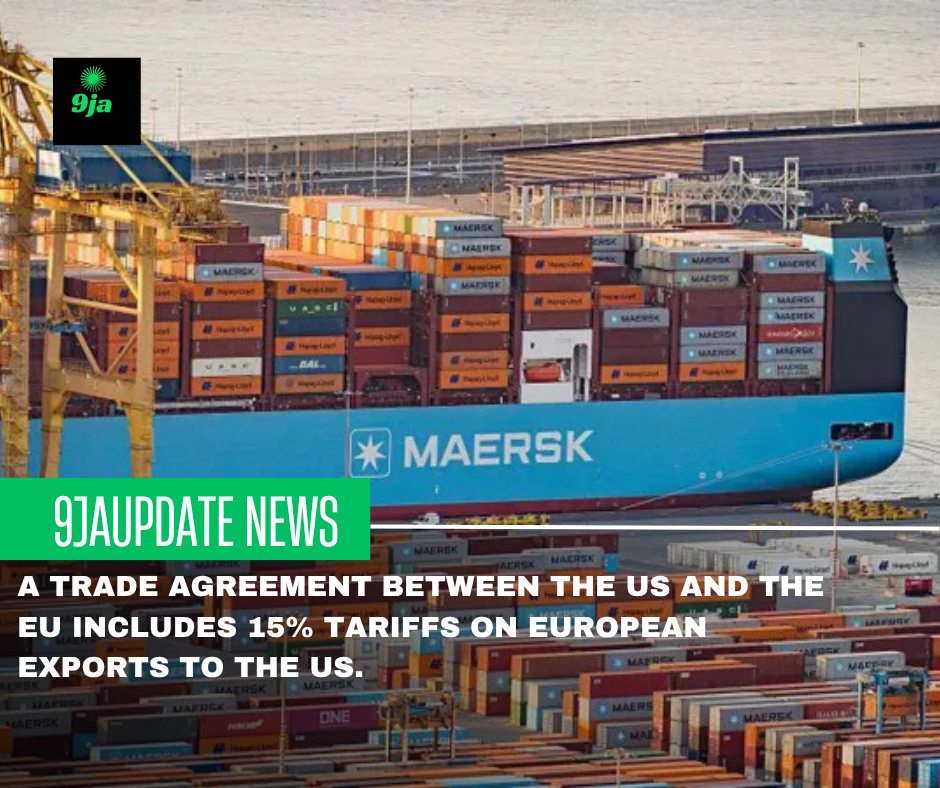
A trade agreement between the US and the EU includes 15% tariffs on European exports to the US.
After months of negotiations, the United States and the European Union have finally reached a framework for a trade agreement.
Following crucial talks in Scotland, President Donald Trump and European Commission President Ursula Von der Leyen reached an agreement on a 15% US tariff on all EU goods.
Trump had threatened to impose a 30% import tax rate beginning on Friday, but that is half of that amount. According to him, the 27-member bloc would allow US exporters to access its markets with zero percent tariffs on specific goods.
Additionally, von der Leyen praised the agreement, stating that it would provide stability for both allies, who together make up nearly one-third of world trade.
Trump has wielded tariffs against major US trade partners in a bid to reorder the global economy and trim the American trade deficit.
As well as the EU, he has struck tariff agreements with the UK, Japan, Indonesia, the Philippines and Vietnam, although he has not achieved his goal of “90 deals in 90 days”.
Sunday’s agreement was announced after private talks between Trump and Von der Leyen at his Turnberry golf course in South Ayrshire.
Trump – who is on a five-day visit to Scotland – said following their brief meeting: “We have reached a deal. It’s a good deal for everybody.”
“It’s going to bring us closer together,” he added.
Von der Leyen also hailed it as a “huge deal”, after “tough negotiations”.
Trump said the EU would boost its investment in the US by $600bn (£446bn), including American military equipment, and spend $750bn on energy.
That investment over the next three years in American liquified natural gas, oil and nuclear fuels would, Von der Leyen said, help reduce European reliance on Russian power sources.
Some goods will not attract any tariffs, including aircraft and plane parts, certain chemicals and some agricultural products. A separate deal on semiconductors may be announced soon.
But a 50% US tariff Trump has implemented on steel and aluminium globally would stay in place, he said.
“I want to thank President Trump personally for his personal commitment and his leadership to achieve this breakthrough,” Von der Leyen said.
“He is a tough negotiator, but he is also a dealmaker.”
Both sides can paint this agreement as something of a victory.